Sorry, this entry is only available in Deutsch.
Category: Computer
(Deutsch) Wichtig! Lesen! Deine @heiniger-net.ch-Mail kostet jetzt!
Lava lamp project, part 3 — mk2
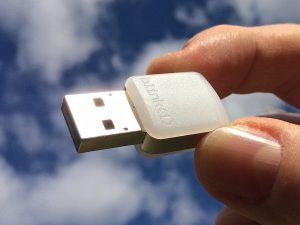 Recently, I stumbled upon an advertisement for this object. It is a gadget called Blink(1), which can be plugged into a USB port and which has two color LEDs, one on top and one on the bottom, that can be controlled by a piece of computer software to show any color in any brightness. The gadget is costing around 40 swiss franks and it has a nice piece of control software, which can be used to make the gadget light in many different useful ways. For example, IFTTT (If This Then That) can be used to make it light in various colors upon given conditions, or URLs, files or scripts can be called to define color combinations, or a mailbox can make it light up if a given number of new mails arrive, or if the mail of your significant other arrives or if the mail has a certain subject line. Or you warn of a low battery, or when the CPU load exceeds a certain percentage.
Lava lamp project, part 2 — firmware
In part 1, I described the hardware of my project of a computer controllable lava lamp. In this second part, I want to discuss the necessary firmware, which is the software necessary to teach the Picaxe Microcontroller the desired functionality.
We need to keep two areas in focus:
- We need to be able to read the desired color values from the USB serial port, defining the desired intensities of the colors green, red and blue.
- These desired values have to be turned into actual light in desired color and intensity. This means, the LEDs have to be turned on.
Lava lamp project, part 1 — hardware
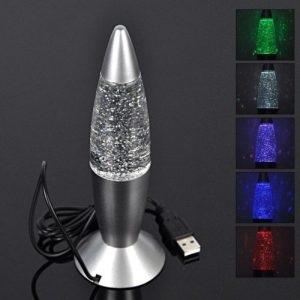 I wanted to build a device that can light in different colors, and where the colors can be controlled from a computer. My idea was to hook it up with a computer, who then should signal some state by lighting the appropriate color. For example, while building and compiling a program, the lamp should blink in blue color. When the build is finished, the lamp should light either in green (when the build ran fine) or red (when something went wrong).
I found the lava lamp shown to the right, which is equipped with a color-changing LED and is powered from USB. I bought one and intended to modify the controlling electronics to my purposes.
Deutsche Firma entwickelt starke Handybatterie mit einer Lebensdauer von 20 Jahren

The youth sector is what makes up the largest population of internet users. According to the latest study by Yahoo! and ad agency Carat Interactive, teens and young adults choose to go online rather than watch television or talk on the phone. The study, which was entitled Born to be Wired, found out that people aged 13 to 24 spend an average of 16.7 hours a week online, excluding e‑mail. Most of the gadgets that teens use are laptops and mobile computers. The trend is expected to go up and if that happens, expect to hear clamour for longer-lasting battery. The biggest hindrance for anyone who wants to be in front of their laptops or mobile computers is the gadgets’ batteries. And a Germany company might just have found a solution to this perennial problem.
Come 2015, teens will have more time on the internet, anytime and anywhere they want. German industrial firm Younicos and renewable power utility company Wemag AG has recently signed an agreement that will put up a 5 MW lithium-ion battery park in West Mecklenburg. The batteries will be supplied by Samsung SDI and each unit will come with 20-year guarantee. For starters, lithium-ion is a type of rechargeable battery that is common on portable gadgets. This includes smartphones and laptops. The first batch of the batteries is expected to be finished by 2014 and among the firsts that will have them are people from Schwerin.
With a 20-year guarantee on your battery, no need to worry if the gadget overheats. You will be able to do your thing as long as you want to. You can play World of Warcraft, poker, Assassin’s Creed or other compelling video games all day. Video gaming is one of the biggest reasons why teens are locked on computers. One of the games that people (mostly young adults) play on mobile computers is poker. The online version of the card game has this imperative effect that is also felt on RPGs. Poker games on websites like partypoker are naturally exciting and fun that some people don’t notice they have been in the game for five straight hours. There are also websites that offer tournaments that give people the chance to qualify for big poker stages namely the European Poker Tour, World Series of Poker, and World Poker Tour. Some of these tournaments follow a marathon format that can last for up to 24 hours.
Aside from the internet users, another party that will benefit on the Li-on deal is Samsung. There’s a big battle on smartphones. Philip Hiersemenzel from the said German firm said that “Samsung SDI’s 20-year guarantee will be the game changer” and that it will make the company more “bankable.”
